Учим английский язык легко и занимательно. Итак, интересные факты про английский. Чем отличается pig от pork, а veal от calf?
Содержание записи:
Интересные факты про английский — I
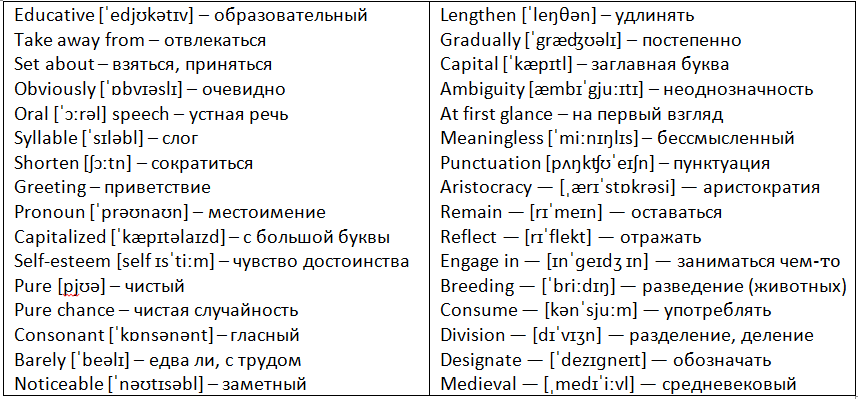
Learning a foreign language is not only educative,
but also amazing if you take a little away from grammar and phonetics [fəˈnetɪks]
and set about learning more about the language itself. Obviously, English is the most widely spoken language in the world
after Chinese [ʧaɪˈniːz] and Spanish [ˈspænɪʃ]:
it is spoken by more than a billion [ˈbɪljən] people. But hardly anyone these three facts about the most spread words we use in everyday life.
Everyone knows the English word «goodbye», which is used when saying goodbye. But few people know that it came from the expression:
«God be with you,» that is, «May the Lord be with you.» The phrase in oral speech shortened over time,
and an extra «o» appeared in the syllable «god» under the influence of the greetings «good morning» and «good day».
Among all languages, English is perhaps the only one in which the pronoun «I» must be capitalized [ˈkæpɪtəlaɪzd].
But this has nothing to do with the high self-esteem of the British, most likely, this is pure chance.
Once upon a time, the first-person pronoun (in Ancient and Middle English) was written as «ic»,
but the consonant [ˈkɒnsənənt] sound «c» was reduced over time. The lone letter «i» in the texts was barely noticeable,
so they began to lengthen it and gradually it turned from a small one into a capital one.
There is an interesting sentence in English, it is used to demonstrate possible lexical [ˈleksɪkəl] ambiguity:
«James while John had had had had had had had had had had had had had a better effect on the teacher».
Интересные факты про английский — II

At first glance, it seems meaningless, but it is grammatically correct. You just should put all the necessary punctuation marks. Then it will look like that:
«James, while John had had «had», had had «had had»;
«had had» had had a better effect on the teacher».
Translated into Russian, it sounds something like this:
«While John used «had», James used «had had»; the teacher preferred «had had».»
After the conquest, French became the language of the ruling class,
the aristocracy [ærɪsˈtɒkrəsɪ], and the feudal [fjuːdl] lords. English remained the language of the lower strata of the population — peasants, artisans and merchants. This linguistic [lɪŋˈgwɪstɪk] division is reflected in the names of animals and products made from them.
Anglo-Saxon peasants who were engaged in breeding and caring about animals used old English names:
cow (корова), pig (свинья), sheep (овца), calf (телёнок).
French feudal lords and aristocrats who consumed meat called ready-made dishes with French words:
beef (from French. bœuf — bull), pork (from French porc),
mutton (from French mouton — ram), veal (from French veau — calf).
Thus, a division arose: live animals retained English names,
and meat served on the table was designated by French words. This reflected the class difference between the Anglo-Saxons and the French in medieval England.
Вопросы
Answer the following questions:
1. According to the text, why can learning a foreign language be amazing beyond just studying grammar and phonetics?
2. Which three languages are mentioned as the most widely spoken in the world? And where does English rank among them?
3. How many people speak English globally, as stated in the text?
4. What is the original meaning and historical origin of the English word goodbye?
5. Why did an extra appear in the word goodbye? And which common greetings influenced this change?
6. What unique feature does the English pronoun I have compared to other languages? And why did this convention develop?
7. How was the first‑person pronoun written in Old and Middle English? And what caused it to evolve into the capitalized I?
8. Why was the lowercase difficult to read in early texts? And how did this lead to its capitalization?
9. What purpose does the sentence James while John had had had had… serve in linguistics? And why does it initially seem meaningless?
10. How does adding punctuation transform the long had‑had sentence into a grammatically correct and meaningful statement? And what is its simplified meaning in Russian?
11. What social groups used French and English after the conquest? And why did this linguistic division emerge?
12. What is the difference in naming animals and meat products in English? And what does it illustrate about medieval English society?
13. How do the examples of animal names (like cow, pig) versus meat names (like beef, pork) reflect the class differences between Anglo‑Saxons and French in medieval England?
Заключение
Итак, дорогие ученики! Мы с вами учимся в 7 классе. Учим английский язык с занимательными фактами со всего света. И сегодня мы узнали про интересные факры английского. Если материал был полезен, подписывайтесь, чтобы не пропустить новый. Задавайте вопросы, если они у вас появились. А также смотрите английские идиомы про знание. Что повлияло на развитие английского языка?
Дополнительный материал
А также смотрите дополнительный материал: подготовка к ОГЭ — монологическое высказывание — Досуг подростков. Телевидение в нашей жизни. Место, где я живу. Поддерживать себя здоровым. Чтение книг. Про интернет. Хобби в нашей жизни. Про каникулы. Средства массовой информации. Про школу. Проблемы экологии. Про молодежь. Интернет в нашей жизни. Олимпийские игры. Наука в нашей жизни. Иностранные языки в нашей жизни. Загрязнение окружающей среды. Иностранные языки в нашей жизни. Про путешествия. Выбираем профессию. Здоровый образ жизни в еде. Про образование. Защита окружающей среды. Спорт в России. Друзья в нашей жизни. Интернет для подростков.
До встречи на следующем занятии! See you soon!