Мы учим английский язык с фактами со всего света в рубрике чтение 8 класс английский язык-29. Итак, человек гигант- существовал ли он на самом деле?
Содержание записи:
Чтение 8 класс английский-29. Человек гигант. Существовал ли он на самом деле?-I

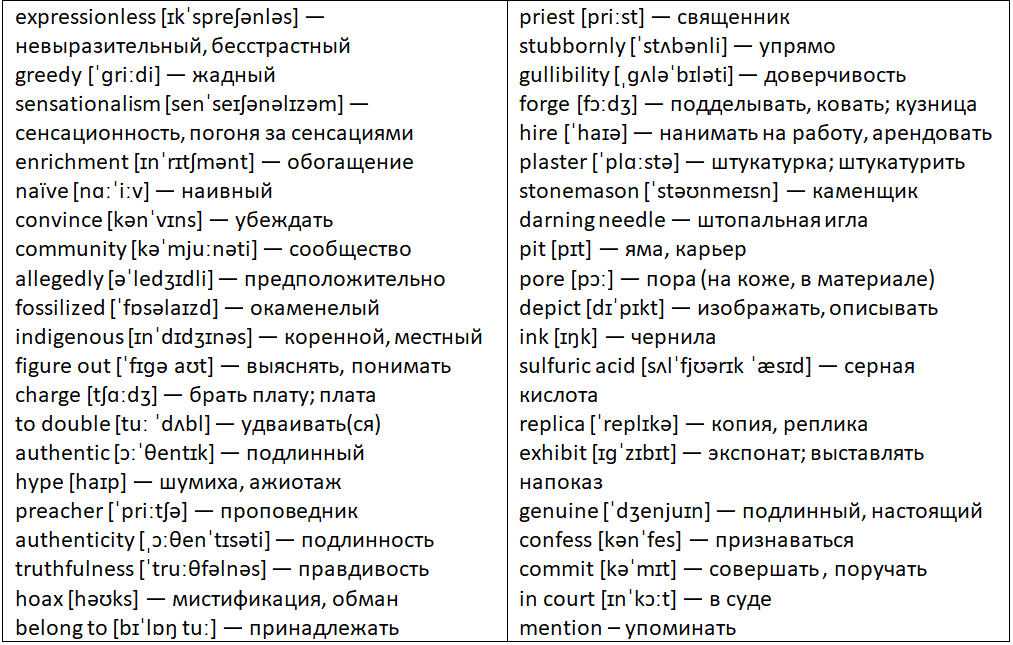
Expressionless everyday life makes people greedy for sensationalism or just beautiful fairy tales. Many people use it for their own pleasure or enrichment. Sometimes it seems that since the Dark Ages, people have not become less naïve [nɑːˈiːv]. There are convincing examples of this.
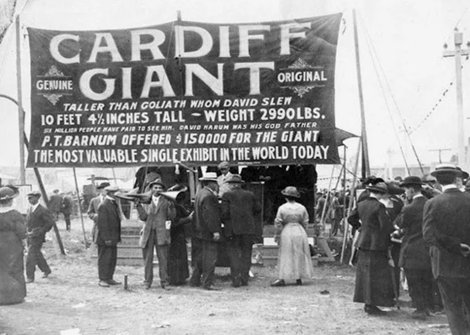
On October 16, 1869, two workers, Gideon Emmons
and Henry Nichols, dug out a well on William Newell’s farm in the community of Cardiff [ˈkɑːdɪf] (New York, USA)
and allegedly discovered the well-preserved fossilized remains of a three-meter man. It was announced that the find dates back to biblical times
and represents the remains of an indigenous American.
The owner of the land, William Newell, quickly figured out how to make money,
and a few days later he began charging those who wanted to see the «giant» —
at first for 25 cents, and soon doubled the price. Despite the fact that the archaeologists immediately stated
that the remains could not be authentic, the hype in the press could not be stopped.
Some Christian preachers even began to defend the authenticity of the find, seeing it as proof of the truthfulness of the biblical [ˈbɪblɪkəl] chronology [krəˈnɒləʤɪ].
The idea of the hoax belonged to George Hull, a New York tobacco [təˈbækəʊ] merchant
and atheist [ˈeɪθɪɪst]. He argued with a Methodist priest who stubbornly defended the lines in the Book of Genesis about the giants who inhabited the Earth. Hull decided to prove people’s gullibility and forged the «giant».
Hull hired workers in Fort Dodge, Iowa, to remove a plaster block about 3.7 m long.
He claimed that the block was needed for the construction of the monument to Abraham [ˈeɪbrəhæm] Lincoln [ˈlɪŋkən] in New York.
Чтение 8 класс английский-29. Человек гигант. Существовал ли он на самом деле?-II
The block was then taken to Chicago [ʃɪˈkɑːgəʊ],
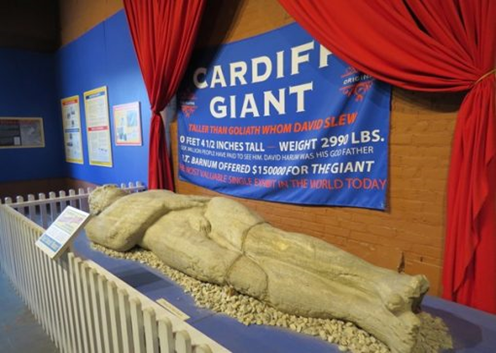
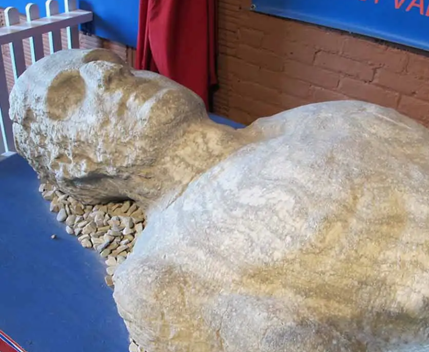
where stonemason Edward Burkhgart carved a sculpture of a man out of it. To make the body look natural, it was pierced with a darning needle
(the pits formed imitated the pores of the skin)
and «veins» were depicted using ink and sulfuric acid.
In November 1868, the sculpture was taken to the farm of Hull’s cousin,
William Newell, and buried under the roots of a tree. A year later, workers allegedly hired to dig out the well «discovered» giant.
Then the Cardiff giant was sold for $23,000 to a group of five people. At this time, the showman Phineas Barnum became interested in it. He offered 50,000 dollars for the sculpture, but was refused. Barnum then hired a man who secretly made a replica of the giant and exhibited it in his museum,
claiming it was a genuine giant and the Cardiff one was a fake.
On December 10, 1869, Hull officially confessed to the press
that he had committed a hoax, and on February 2, 1870, both giants were found to be fake ones in court. Despite this, Barnum managed to order and sell several copies of the statue.
Later, the Cardiff giant exhibited at the 1901 Pan American Exposition, but did not attract much attention.
In 1947, it was bought by the Farmers Museum in Cooperstown, New York, where it is still on display.
The Cardiff giant is mentioned in a number of works of fiction,
for example in the stories of Mark Twain, Ray Bradbury, Howard Lovecraft and Stephen King. In 2011, artist Ty Marshall created a life-size replica of it from a hypertufa.
This story shows how easily people can believe in the unbelievable,
especially if it is backed by authority or backed by a media wave.
Вопросы
What makes people greedy for sensationalism or fairy tales according to the text?
2. When and where did Gideon Emmons and Henry Nichols allegedly discover the fossilized remains of the three‑meter man?
3. What was claimed about the origin and age of the “Cardiff giant”?
4. How did William Newell try to profit from the find, and how did the ticket price change?
5. What was the reaction of archaeologists to the discovery, and did it stop the public excitement?
6. Who came up with the hoax idea, and what personal reason did he have for creating the fake giant?
7. Describe the main steps George Hull took to create the fake giant (from the block to the carving).
8. How did the sculptor Edward Burkhgart make the body look more natural?
9. When was the sculpture buried on William Newell’s farm, and when was it “discovered”?
10. What happened after the Cardiff giant was sold for $23,000, and how did Phineas Barnum get involved?
11. When did George Hull confess to the hoax, and what was the official conclusion of the court?
12. Where is the Cardiff giant displayed now, and how is it referenced in culture?
Заключение
Дорогие ученики! Мы с вами учим английский язык с фактами со всего света. Если информация была для вас занимательной, подписывайтесь на нас. Оставляйте свои комментарии и пожелания, если они у вас также возникли. Предыдущий материал — чтение, юные изобретатели, Блез Паскаль. Подземный храм.Как развлекаются японцы? Почему тайцы ставят тарелки на пол. Юные изобретатели — кто придумал шрифт для слепых. Чтение — юные изобретатели: кто придумал батут? Кто придумал снегоход? Такое необычное существо — пиявка! Дерево, украшенное ботинками. Муравьи зомби. Идиомы про учебу. Жутко ужасные — необычная семья. Самый маленький человек на свете. Загадочный круг из камней. Учимся разговаривать про окружающую среду. Ужасающий цветок. Бессмертное существо. Девушка подросток оказалась взрослым мужчиной. Король уродов в цирке. Самый населенный город, который был уничтожен. Почему нельзя не есть яблоки? Почему была покинута целая деревня? Самое опасное дерево.
Также смотрите — фразовые глаголы про учебу. Фразовые глаголы про путешествия. Фразовые глаголы про эмоции. Синонимы слова different. Синонимы say tell. Фразовые глаголы про отношения между людьми. Фразовые глаголы про технологии. Синонимы слова lazy. Английские фразы про Helloween. Фразовые глаголы про хобби. Характеристики человека-1. Синонимы слова look. Глаголы животные в английском. Идиомы с одеждой. Чтение в 8 классе — гора крестов. Как развлекаются японцы. Синонимы слова end. Фразовые глаголы про спорт. Птица, которая копирует все. Характеристики человека-2. Характеристика человека-3. Характеристика человека-4. Артикли-1. Артикли-2. Артикли-3. Артикли-4. Артикли-5. Артикли-6. Артикли-7. Артикли-8. Артикли-9. А также смотрите синонимы слова important. Синонимы слова happy. Он мечтал стать черепом. Человек, который продлили войну на 30 лет.
Дополнительный материал
А также смотрите дополнительный материал: подготовка к ОГЭ — монологическое высказывание — Досуг подростков. Телевидение в нашей жизни. Место, где я живу. Поддерживать себя здоровым. Чтение книг. Про интернет. Хобби в нашей жизни. Про каникулы. Средства массовой информации. Про школу. Проблемы экологии. Про молодежь. Интернет в нашей жизни. Олимпийские игры. Наука в нашей жизни. Иностранные языки в нашей жизни. Загрязнение окружающей среды. Иностранные языки в нашей жизни. Про путешествия. Выбираем профессию. Здоровый образ жизни в еде. Про образование. Защита окружающей среды. Спорт в России. Друзья в нашей жизни. Интернет для подростков.
До встречи на новом занятии! See you soon!